This site contains affiliate links, view the Disclaimer for more information.
USB charging or a replaceable AAA? Start with the way you carry your keys, then compare controls, useful low modes and the charging routine.
Decide what this little light needs to do
A keychain light is useful for the front door, a dark stairwell or finding something beside the car. It can also serve as a spare. A long unlit walk asks more of runtime, grip and beam coverage; a tiny light is not automatically the right primary light for it.
Start with your keys on the table. Is there room for another rigid object without pressing a car remote or digging into your leg? Consider the whole bundle, including the split ring and clip. A very short light with an awkward attachment can carry less comfortably than a slightly longer one.
Two different routines: TIP3 and i3E EOS
| Decision | NITECORE TIP3 | OLIGHT i3E EOS |
|---|---|---|
| Power routine | Built-in rechargeable battery; USB-C charging | Replace the compatible AAA cell; no USB port |
| Control style | Two buttons; learn modes and lockout | Twist the head for on/off |
| Why consider it | You want selectable settings and color temperatures | You value a simple control and replaceable-cell routine |
| What to check | Charging access, lockout steps and low-mode access | Whether a twist head works for your hands and key bundle |
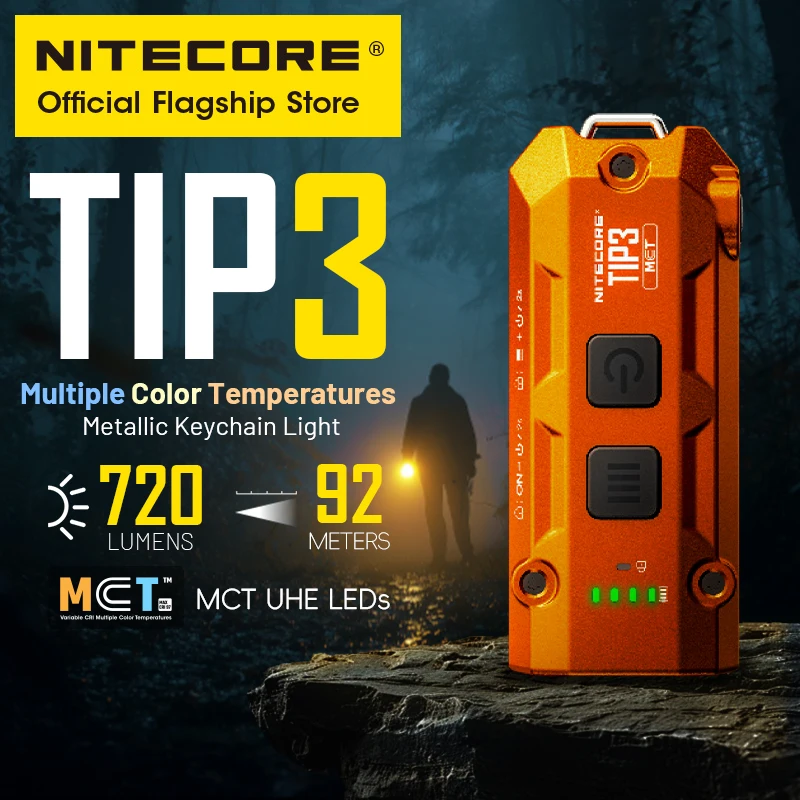
These are different approaches, rather than a brightness ranking. The TIP3’s manufacturer lists three color temperatures: 3000K, 4500K and 6500K. That offers a way to choose the appearance of the light; it does not establish high color rendering or a measured advantage on your route. The i3E’s simpler interface means less to learn, but also less control over brightness.
Read the low setting before the maximum
At a front door, you need enough light to see the lock without flooding a nearby person’s face. For a late-night indoor task, a directly accessible low mode can matter more than peak output. Look for the exact sequence from off: a single press, a hold, or a twist. Check whether that action recalls a previous bright setting.
Read a runtime table by mode. A maximum-output number and a longest-runtime number often describe different settings. A brief turbo output should not be treated as what the light maintains throughout the quoted runtime. We have not measured the sustained output of these lights.
Make accidental activation part of the decision
A pocket can press a side button. Read the model’s lockout instructions and try the sequence while the light is cool, before carrying it against fabric. Check that unlocking is still manageable with cold hands. A lockout that is too fiddly to use each day is a practical disadvantage even if it looks good in a feature list.
For a twist light, understand how far the head needs to move and how it stays attached. Do not assume that unscrewing farther is safer; follow its instructions. Keep the lens from rubbing against sharp keys when possible.
A useful purchase checklist
- Check the complete light dimensions and weight with its battery, not only the bare body.
- Read how to reach low, turn off, and lock the light without passing through a bright mode.
- Confirm the charging cable or exact cell type you will need. USB-C on a light and USB-C on a removable cell are different arrangements.
- Check water resistance for the exact model. A charging port cover, if fitted, must be used as instructed; a small light is not automatically a dive light.
- Compare the delivered cost of the selected finish and battery bundle. Do not pay for a special finish unless you actually want it.
For a light that mostly opens doors and backs up another light, the i3E style deserves a look. For more control over settings and the appearance of the beam, compare the TIP3. For longer walks, read our beam and runtime guide before shrinking everything down to a keychain.
Sources and model notes
This is a comparison of documented features, not a hands-on review. Refer to the NITECORE TIP3 product information, TIP3 manual, and OLIGHT i3E EOS manual. Marketplace images and links below come from the affiliate catalog; selected variants, current stock and seller claims should be checked at checkout.
What to look for
Compare the model numbers and fit details before ordering. Check the selected variant, battery bundle and seller before ordering.
NITECORE TIP3
A rechargeable keychain option with selectable color temperatures. Seller photo shows an orange finish; confirm your selected color and included accessories. Peak output is not a sustained-output promise.
View on AliExpress
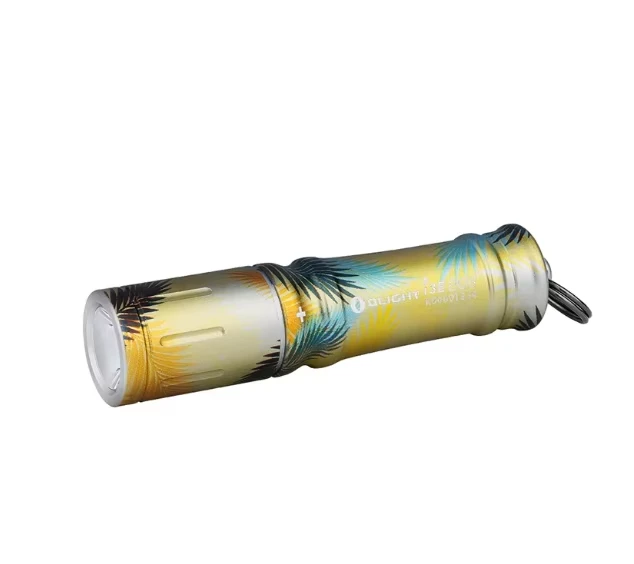
OLIGHT i3E EOS
A twist-operated AAA keychain alternative for simple on/off use. The pictured decorative finish is one listing option; check the chosen finish and battery bundle. No onboard USB charging.
View on AliExpress